
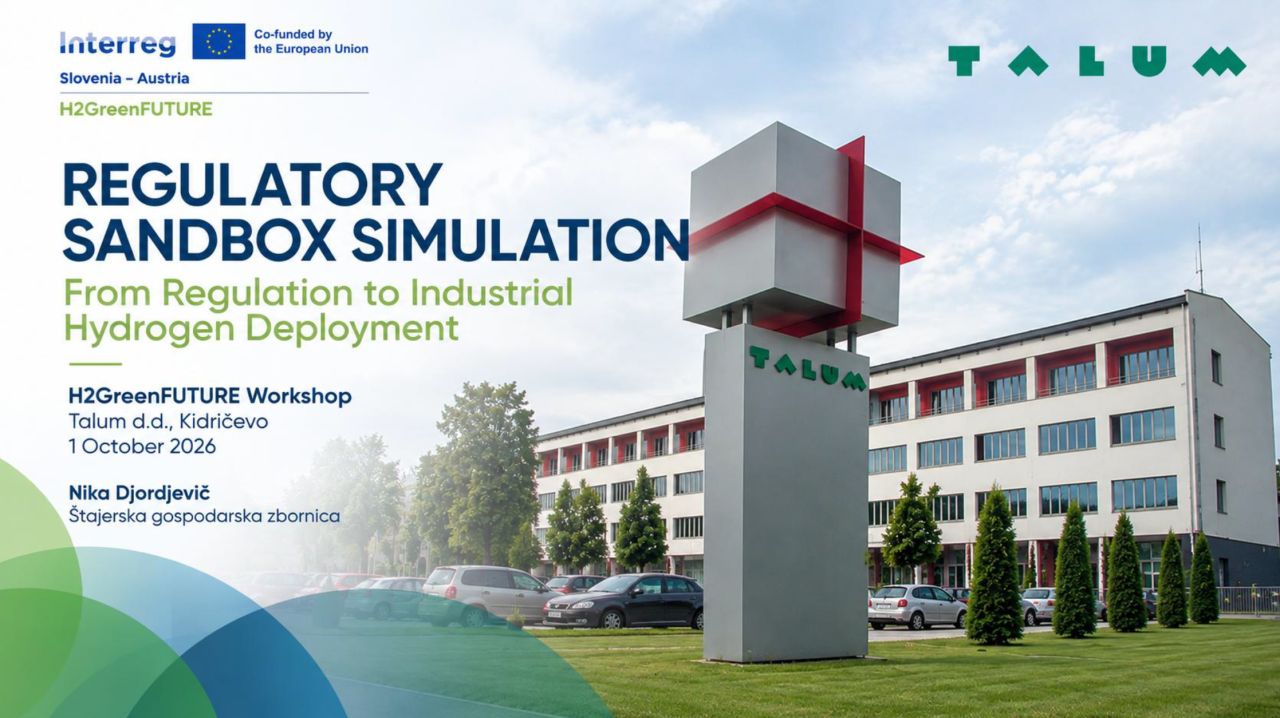
How can innovative hydrogen technologies be more effectively transferred from pilot projects to industrial practice? This was the central question of the “H2 Regulatory Sandbox Simulation” workshop, organized by the Styrian Chamber of Commerce on October 1, 2026, as part of the H2GreenFUTURE project at TALUM d. d. in Kidričevo.
The development of hydrogen technologies presents more than just technical challenges. When actually applying these technologies in industry, companies also face issues related to legislation, permits, safety, infrastructure, the jurisdiction of various institutions, and procedures that were not necessarily designed for new technologies and new ways of using them.
This is precisely the purpose of the regulatory sandbox concept—an environment in which it is possible to test, using a concrete example, how the existing regulatory framework works in practice, where obstacles or ambiguities arise, and which solutions would enable a safer, faster, and more predictable introduction of innovations.
From Pilot Project to Industrial Use of Hydrogen
The workshop brought together industry representatives, experts, project partners, and other stakeholders from Slovenia and Austria. Participants first learned about the H2GreenFUTURE project and the concept of a regulatory sandbox as one of the possible tools for more effective implementation of innovative hydrogen solutions.
A significant part of the meeting was devoted to TALUM’s specific experiences. Dragan Mikša from TALUM presented the technical and organizational aspects of the transition from a pilot project to industrial practice, as well as experiences related to technical readiness, process stability, product quality, safety, infrastructure, and opportunities for the broader application of hydrogen technologies.

As part of a guided tour, participants also observed the company’s production processes, gaining firsthand insight into the environment where new energy and technological solutions meet the demands of real-world industrial production.

Testing Regulations Using a Concrete Example
A key part of the workshop was the regulatory sandbox simulation itself. Instead of a general discussion of legislation, the focus was on a practical question: where would the greatest obstacles or ambiguities arise in the implementation of a specific hydrogen application project from the perspective of various professional and institutional fields, and what would need to be addressed to ensure its successful implementation?
Through group work and discussion, participants identified regulatory and other barriers, compared the perspectives of various stakeholders, and developed possible solutions and next steps.

This approach ensures that regulatory issues are not addressed in isolation from technology and industrial realities, but rather in collaboration with companies, experts, research organizations, policymakers, and other institutions involved in the adoption of new technologies.
At the workshop, a representative from LEC GmbH in Graz also presented the development of their Zero Impact Demonstrator and their experiences in developing a hydrogen ecosystem in Austria, thereby adding an important cross-border dimension to the discussion.

Findings Also Form the Basis for H2GreenFUTURE Recommendations
The simulation findings will be used in further activities of the H2GreenFUTURE project and in the preparation of Policy Brief recommendations aimed at more effective implementation of hydrogen technologies in practice.
Above all, the workshop highlighted the importance of early collaboration between industry, experts, and institutions. With new technologies, the question is not only whether a particular solution is technically feasible, but also whether the regulatory and institutional environment enables its safe, predictable, and economically viable use.
A regulatory sandbox is therefore not an end in itself. The goal is to create the conditions for the safe and predictable industrial use of hydrogen and to enable technological innovations to be implemented more quickly.
The Styrian Chamber of Commerce would like to thank TALUM d. d., all speakers, project partners, and participants for their active involvement, the exchange of experiences, and the open professional discussion.
By bringing together knowledge, industrial experience, and regulatory perspectives, the H2GreenFUTURE project contributes to creating the conditions for the further development of the hydrogen ecosystem and the low-carbon transition in the cross-border region of Slovenia and Austria.